Rental Property Valuation Calculator
Enter the rent, expenses, a cap rate and a GRM to see the value each method gives.
Recent
Your last 10 settings, saved only in this browser. Nothing is uploaded.
How to use the rental property valuation calculator
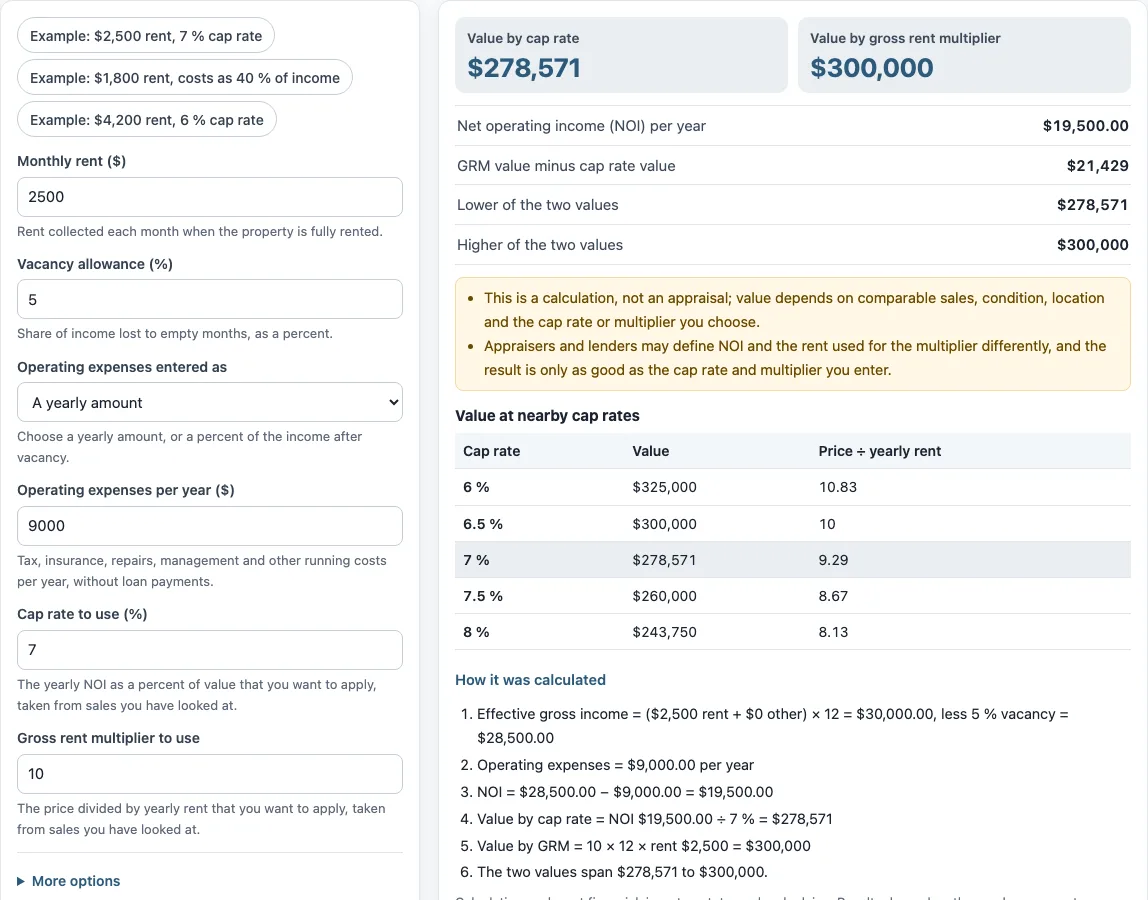
- Enter the “Monthly rent ($)”, which is the rent collected each month when the property is fully rented.
- Enter the “Vacancy allowance (%)”, which is the share of income lost to empty months.
- Choose how running costs are entered under “Operating expenses entered as:”: “A yearly amount” or “A percent of income”.
- Fill in “Operating expenses per year ($)” or “Operating expenses (%)”, depending on your choice. Include tax, insurance, repairs and management, but leave out loan payments.
- Open “More options” to enter “Other income per month ($)”, such as parking or laundry. It counts toward the cap rate value but not the GRM value.
- Enter the “Cap rate to use (%)” and the “Gross rent multiplier to use” from comparable sales. The tool does not supply these figures.
- Read the results: “Value by cap rate”, “Value by gross rent multiplier”, “Net operating income (NOI) per year”, “GRM value minus cap rate value”, “Lower of the two values” and “Higher of the two values”. Open “How it was calculated” under the result to see each step with your numbers.
The three preset buttons load example sets. The values in the form are examples, not market data, so replace every one with your own. “Copy link” reopens the same inputs, “Print / save result” prints a one-page sheet (save it as PDF from the print dialog), and “Reset” restores the example values.
How do you value a rental property from its income?
Divide the net operating income (NOI) by a cap rate: value = NOI ÷ cap rate. NOI is the effective gross income minus operating expenses, where effective gross income is the rent plus any other income, multiplied by 12, less the vacancy allowance.
In the tool’s example, $2,500 rent gives $30,000.00 a year, less 5% vacancy gives $28,500.00. Subtracting $9,000.00 of operating expenses gives NOI of $19,500.00. Dividing by a 7% cap rate gives a value by cap rate of $278,571.
What is the difference between the cap rate method and the GRM method?
The cap rate method values the property from NOI, after vacancy and operating expenses. The gross rent multiplier (GRM) method multiplies the annual gross rent by a multiplier taken from comparable sales: value = GRM × annual gross rent. It uses rent only, so other income does not count toward the GRM value, and vacancy and expenses are not deducted.
In the example, a GRM of 10 gives 10 × 12 × $2,500 = $300,000. The gap between the two methods is shown as “GRM value minus cap rate value”, which is $21,429 here. The tool shows both values and the range between them, $278,571 to $300,000, and does not pick one for you.
Lenders and appraisers may define NOI and the rent used for a multiplier differently, so their figures can differ from these.
Where do the cap rate and the gross rent multiplier come from?
The tool does not supply either figure. A cap rate is normally taken from sales of comparable properties by dividing each sale’s NOI by its price, and a gross rent multiplier by dividing each sale price by its annual rent. You type the figure you have chosen into “Cap rate to use (%)” or “Gross rent multiplier to use”. The value changes with that choice: in the default example a 7 % cap rate gives $278,571, and a lower cap rate on the same NOI would give a higher value, because value = NOI ÷ cap rate. The tool also shows the lower and higher of the two values, so the range between the methods is visible.
What do I enter as operating expenses?
Enter the running costs of the property before the mortgage: property tax, insurance, repairs and maintenance, and management. Leave out loan payments, depreciation and income tax. In the default example the operating expenses are $9,000 a year. If you choose “A percent of income”, the percentage is applied to the effective gross income instead of a yearly amount.
Sources: Corporate Finance Institute: Capitalization rate, Corporate Finance Institute: Gross rent multiplier.
Frequently asked questions
Is this an appraisal?
No. The tool gives a calculation only. A valuation also uses comparable sales, condition and location, and appraisers follow professional standards.
Where do the cap rate and gross rent multiplier come from?
They come from sales you have looked at, usually comparable sales. You type them in, and the tool does not look up prices or rents.
Can I use the results in reports or listings?
Yes. Results may be used in commercial work, such as reports, listings, lease comparisons and client documents, without attribution. The tool gives no investment, loan, tax or legal advice.
Does the tool save my numbers?
Everything runs in your browser and nothing you type is uploaded. To keep your inputs, use “Copy link” or “Print / save result”.
Why do the two values differ?
The cap rate method uses NOI, so it reflects vacancy and operating expenses. The gross rent multiplier method uses gross rent only. In the default example the gap is $21,429, and the tool shows both values and the range between them without picking one.
Can I value a commercial property this way?
The arithmetic is the same for commercial property: NOI divided by a cap rate, or a multiplier times annual rent. Enter the rent, vacancy and operating expenses of the commercial property, and use a cap rate or multiplier from comparable commercial sales. Lenders and appraisers may define NOI differently.
Related tools
- Rental property calculator: use it for a broader look at a rental property’s numbers.
- Investment property calculator: use it when you are comparing investment property figures.
- Rental ROI calculator: use it to work out the return on a rental property.
- Rental property cash flow calculator: use it to look at the money left after running costs and loan payments.
- Cash on cash return calculator: use it to measure the return on the cash you put into a property.
- BRRRR calculator: use it for buy, rehab, rent, refinance, repeat figures.
- Buy to let mortgage calculator: use it to work out mortgage payments on a buy-to-let property.