Rental Property Cash Flow and Profit Calculator
Enter the rent, expenses and loan to see the monthly and annual cash flow line by line.
Recent
Your last 10 settings, saved only in this browser. Nothing is uploaded.
How to use the Rental property cash flow calculator
- Enter the “Purchase price ($)” and the “Down payment (%)”. A down payment of 100 means no loan.
- Enter the “Mortgage interest rate (%)” and “Loan term (years)” from your lender’s quote.
- Enter “Closing costs ($)” as you know them from the purchase paperwork.
- Enter “Monthly rent, all units ($)” for the property when fully rented, and the “Number of units”.
- Open “More options” to add “Other income per month ($)”, “Repair and rehab costs ($)”, “HOA fees per year ($)”, “Utilities paid by the owner per year ($)” and “Other operating costs per year ($)”. Tick “Interest-only payments” if it applies.
- Enter the “Vacancy allowance (%)”, “Property tax per year ($)”, “Insurance per year ($)”, “Maintenance and repairs (%)”, “Property management (%)” (0 if you manage it yourself) and “Capital reserves (%)”.
- Read “Cash flow per month”, “Cash flow per year”, “Cash flow per unit per month”, “Net operating income (NOI) per year”, “Monthly rent at which cash flow is zero” and “Break-even occupancy”. Check the “Income and expenses” table and “How it was calculated” for each line.
The three preset buttons, “Example: starter condo with HOA fees”, “Example: duplex, two units” and “Example: single-family house, higher rate”, fill the form for you as a starting point. “Reset” restores the example values. “Print / save result” prints a one-page sheet with the inputs, results, calculation steps and date; save it as PDF from the print dialog. “Copy link” copies a link that reopens the same inputs, and the page address keeps your inputs after any change.
How do you calculate cash flow on a rental property?
Rental cash flow is net operating income (NOI) minus debt service minus capital reserves. The tool works through these parts in order, so you can trace every result line by line.
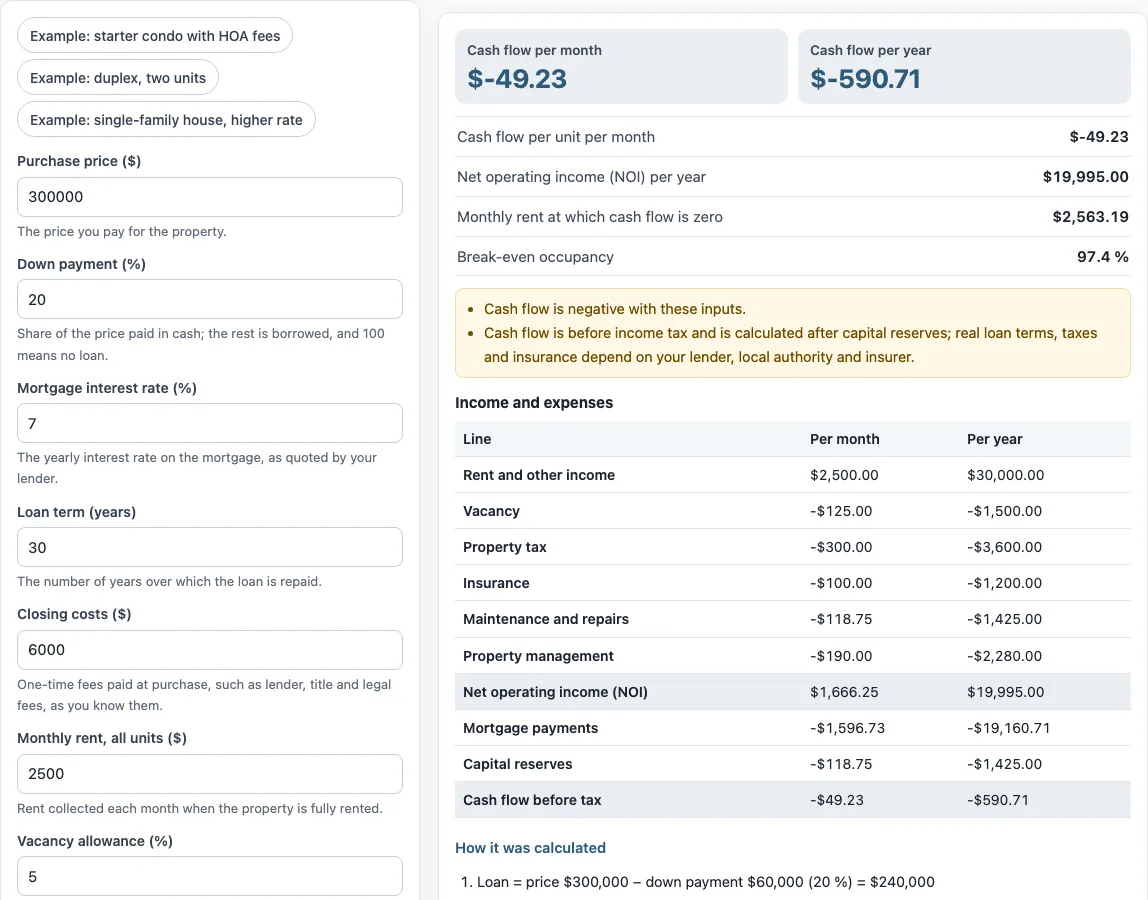
Income comes first. Monthly rent for all units plus other income, multiplied by 12, gives the gross figure. The “Vacancy allowance (%)” is then taken off. In the example, $2,500 rent with $0 other income gives $30,000.00 a year, and 5% vacancy removes $1,500.00, leaving $28,500.00.
Operating expenses come next. Fixed costs of $4,800.00, plus maintenance of $1,425.00 and management of $2,280.00, total $8,505.00. NOI is income minus operating expenses: $28,500.00 − $8,505.00 = $19,995.00. NOI is calculated before any loan payment. Lenders or appraisers may define it differently.
Debt service is the mortgage. The loan is $300,000 − $60,000 = $240,000, with a monthly payment of $1,596.73, or $19,160.71 a year. Subtracting that payment and the $1,425.00 of capital reserves gives 19,995.00 − 19,160.71 − 1,425.00 = −$590.71 per year, or −$49.23 per month.
Cash flow per unit divides the result by the number of units you enter.
What is break-even rent?
Break-even rent is the monthly rent at which cash flow is zero, with all other inputs unchanged. The tool adds the fixed costs and the mortgage payment for the year, divides by 12 times 0.779, and subtracts other income. The 0.779 is the share of each rent dollar kept after vacancy, maintenance, management and reserves. In the example, ($4,800.00 + $19,160.71) ÷ (12 × 0.779) − $0 = $2,563.19 per month.
Break-even occupancy is the occupancy share at which cash flow is zero. In the example it is 97.4%. Both figures change when any input changes, so they show the result for the inputs currently on the page.
Why does the tool show break-even occupancy?
Break-even occupancy is the share of the rent that must actually be collected for cash flow to be zero. It is 97.4 % in the default example, which means a small amount of extra vacancy would turn a small shortfall into a larger one. Because maintenance, management and reserves are percentages of collected income, they fall when vacancy rises, so the occupancy figure is worked out with that in mind. Compare it with the vacancy allowance you entered: the closer the two are, the less room the numbers leave. The tool also shows the break-even rent, so you can see the same margin in dollars instead of a percentage.
Sources: Corporate Finance Institute: Net operating income, CFPB: What is an amortization schedule?.
Frequently asked questions
Does cash flow include principal payments?
Cash flow subtracts the full mortgage payment, which covers both interest and principal. How each payment splits between the two is explained in the CFPB amortization material. The tool’s profit leaves out principal paid off, so loan repayment is not counted as a gain. Interest-only payments keep the loan balance the same.
How do I find cash flow per unit?
Divide the cash flow by the number of units. The tool does this for you when you enter the “Number of units”. The example has one unit, so “Cash flow per unit per month” shows the same −$49.23 as “Cash flow per month”.
Is a rental profit calculator the same as a cash flow calculator?
People use profit and cash flow loosely in searches. This tool’s profit is pre-tax cash flow. It leaves out principal paid off, appreciation and income tax.
Does the tool calculate income tax or depreciation?
No. Cash flow is shown before income tax. The tool does not calculate taxes, depreciation or capital gains. Real loan terms, taxes and insurance depend on your lender, local authority and insurer.
Can I use it for a vacation rental?
The tool takes one monthly rent figure. For a short-term rental, enter a monthly average that you have worked out yourself. The tool does not look up rents.
Are the example values real market figures?
No. The values in the form are an example, not market data. Replace every one with your own numbers.
Related tools
- Rental property calculator: use it to run a general rental property analysis alongside your cash flow figures.
- Investment property calculator: use it when you are comparing the costs and income of an investment property.
- Rental ROI calculator: use it to see the return on the rental relative to the money you put in.
- Cash on cash return calculator: use it to measure the annual cash flow against the cash you invested.
- BRRRR calculator: use it for a buy, rehab, rent, refinance, repeat strategy.
- Rental property valuation calculator: use it to estimate the property’s value based on its rental income.
- Buy to let mortgage calculator: use it to work out mortgage payments for a buy-to-let property.