Gross Lease vs Net Lease Calculator
Enter the two offers to compare their total cost over the term.
Recent
Your last 10 settings, saved only in this browser. Nothing is uploaded.
The gross lease vs net lease calculator compares the total cost of a gross or modified gross lease with a net lease for the same space and term, and shows which total is lower. You enter the area, the term from 1 to 30 years, and the rent and yearly increases for each lease. The tool runs in your browser, is free, and needs no account or sign-up.
A gross lease puts building operating expenses inside one rent. A net lease charges base rent and then adds a share of taxes, insurance and common-area maintenance (CAM) on top. Because the two leases state their costs differently, the calculator adds up each lease year by year so you can compare the totals over the full term.
How to use the Gross vs net lease calculator
- Enter the “Leased area (ft²)”. The same area is used for both leases.
- Set the “Lease term (years)” from 1 to 30.
- Choose the “Lease A type”: “Gross (expenses included in the rent)” or “Modified gross (base year)”.
- Enter the “Lease A rent per square foot per year ($)” and the “Lease A rent increase per year (%)”.
- If you chose modified gross, enter the “Building expenses in the base year, per square foot ($)” and the “Yearly increase in building expenses (%)”.
- Enter the “Lease B base rent per square foot per year ($)” and the “Lease B base rent increase per year (%)”.
- Enter the “Lease B taxes, insurance and CAM per square foot per year ($)” and the “Lease B yearly increase in those charges (%)”.
- Read the results: “Lease A total cost over the term”, “Lease B total cost over the term”, “Difference (B − A)” and “Lower total”. Check “Cost by lease year” for the year-by-year figures.
To begin, click a preset such as “Example: gross lease vs net lease, 5 years”, then replace each value with your own numbers. “Reset” restores the example values. “Copy link” copies a link that reopens the same inputs. “Print / save result” prints a one-page sheet with the inputs, results, calculation steps and date; choose Save as PDF in the print dialog.
How do I compare a gross lease with a net lease?
Put both leases on the same footing: the same area, the same term, and a total for each year. The calculator does this by setting Lease A’s yearly rent against Lease B’s base rent plus its pass-through charges, then adding each lease’s years together.
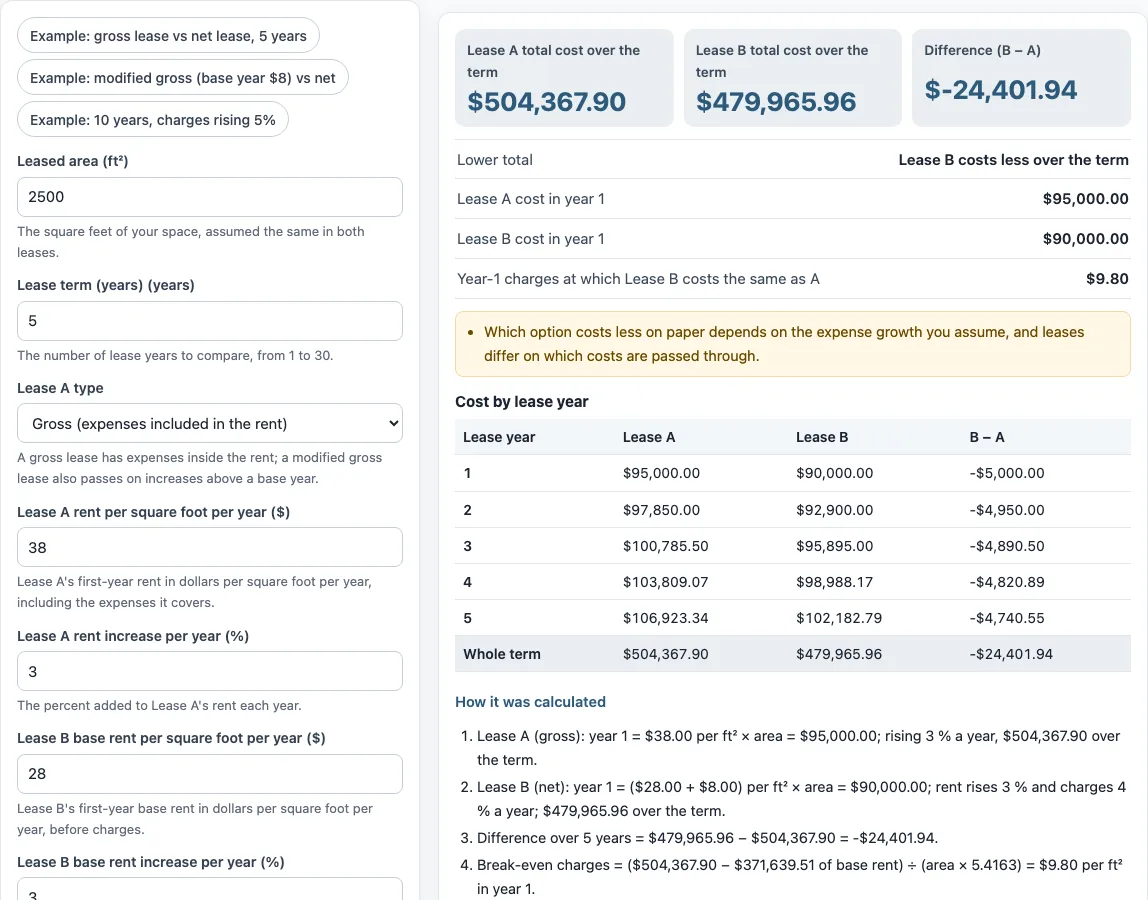
Lease A’s yearly cost is its rent per square foot times the area, rising by its yearly percentage. Lease B’s yearly cost is its base rent plus taxes, insurance and CAM, each rising by its own percentage. In the default example, year 1 for Lease A is $38.00 per ft² × area = $95,000.00. For Lease B it is ($28.00 + $8.00) per ft² × area = $90,000.00. Over 5 years, Lease A totals $504,367.90 and Lease B totals $479,965.96. The difference, B − A, is -$24,401.94, so the tool shows Lease B as the lower total in this example.
The tool also shows the “Year-1 charges at which Lease B costs the same as A”. In the example this is $9.80 per ft² in year 1. It is found by taking Lease A’s total minus Lease B’s base rent total of $371,639.51, then dividing by the area times 5.4163. This value is not shown when Lease B’s base rent alone is already higher than Lease A’s total.
Leases differ in which costs they pass through, and terms are defined in each lease document. Check what each lease covers before you enter its numbers.
What is a modified gross lease?
A modified gross lease is a lease where the rent includes building expenses up to a base year. The tenant pays only the increases in building expenses above that base-year level. It sits between a gross lease, where the rent covers all expenses, and a net lease, where the tenant pays a share of the expenses on top of base rent.
To model it, choose “Modified gross (base year)” as the “Lease A type”. The tool then shows two extra fields: the base-year building expenses per square foot and their yearly increase. Each year, the tool adds the rise in building expenses per square foot above the base year to Lease A’s cost. Some leases define the base year or the expense categories differently, so use the figures from your own lease.
Sources: Wikipedia: Gross lease, Wikipedia: Net lease.
Frequently asked questions
Does this tool tell me which lease is better?
No. The calculator is arithmetic only. It shows which total is lower for the numbers you enter, and it gives no investment, loan, tax or legal advice.
Why does the result depend on expense growth?
Lease B’s pass-through charges rise by the percentage you set, and a modified gross Lease A pays the rise in building expenses above its base year. Because these yearly increases compound over the term, changing the growth rates can change which total is lower. The tool notes this, since which lease costs less on paper depends on the expense growth you assume.
Are the values in the form market data?
No. The values already in the form are an example, not market data. Replace every one with your own numbers.
Are triple net and NNN the same as the net lease here?
On this page, “triple net”, “NNN” and “net” all refer to the Lease B side of this comparison. Lease terms still vary, so check which costs each lease passes through.
Does the tool upload what I type?
No. The calculation runs in your browser, and nothing you type is uploaded.
Can I use the results in client documents?
Yes. Results may be used in commercial work, such as reports, listings, lease comparisons and client documents, without attribution.
Related tools
- Commercial lease calculator: use it to work through a commercial lease cost before comparing lease types.
- Triple net lease calculator: use it when you want to focus on the costs of a triple net lease alone.
- CAM charges calculator: use it to work out common-area maintenance charges for Lease B’s pass-through input.
- Rentable vs usable square feet calculator: use it to compare rentable and usable area before you set the leased area.
- Tenant improvement allowance calculator: use it when an allowance for improvements is part of the lease package.
- Percentage rent calculator: use it when a lease includes rent based on a share of sales.
- Rent per square foot calculator: use it to convert a monthly or annual rent into a per square foot figure.
- Rent escalation calculator: use it to model how rent rises over the years of a lease.