Cash on Cash Return Calculator
Enter the price, down payment, rent and costs to get cash flow and cash on cash return.
Recent
Your last 10 settings, saved only in this browser. Nothing is uploaded.
The cash-on-cash return calculator works out the yearly cash return on the cash you put into a rental property, as a percentage. It divides the yearly pre-tax cash flow by the cash invested, which is the down payment plus closing costs and any rehab costs. This is the cash on cash return formula used in real estate, and the page treats cash on cash ROI, yield and return as the same measure.
The tool runs in the browser. It is free, with no account or sign-up needed, and nothing you type is uploaded. The result covers one year and is before income tax. You can change the price, loan, rent and expenses to see how each input moves the result.
How to use the cash on cash return calculator
- Enter the “Purchase price ($)” and the “Down payment (%)”. Use 100 for no loan.
- Enter the “Interest rate (%)” and “Loan term (years)”. Tick “Interest-only payments” if the payment covers interest only and the balance stays the same.
- Enter the “Closing costs ($)” paid at purchase.
- Enter the “Monthly rent ($)” and the “Vacancy allowance (%)”.
- Enter “Property tax per year ($)”, “Insurance per year ($)”, “Maintenance, % of collected rent (%)”, “Management, % of collected rent (%)” and “Capital reserves, % of collected rent (%)”. Use 0 for management if you manage the property yourself.
- Open “More options” to enter “Rehab or repair costs ($)”, “Other income per month ($)”, “HOA dues per year ($)”, “Utilities paid by the owner per year ($)” and “Other operating expenses per year ($)”.
- Read “Cash-on-cash return” and check the “Cash invested” figure beside it.
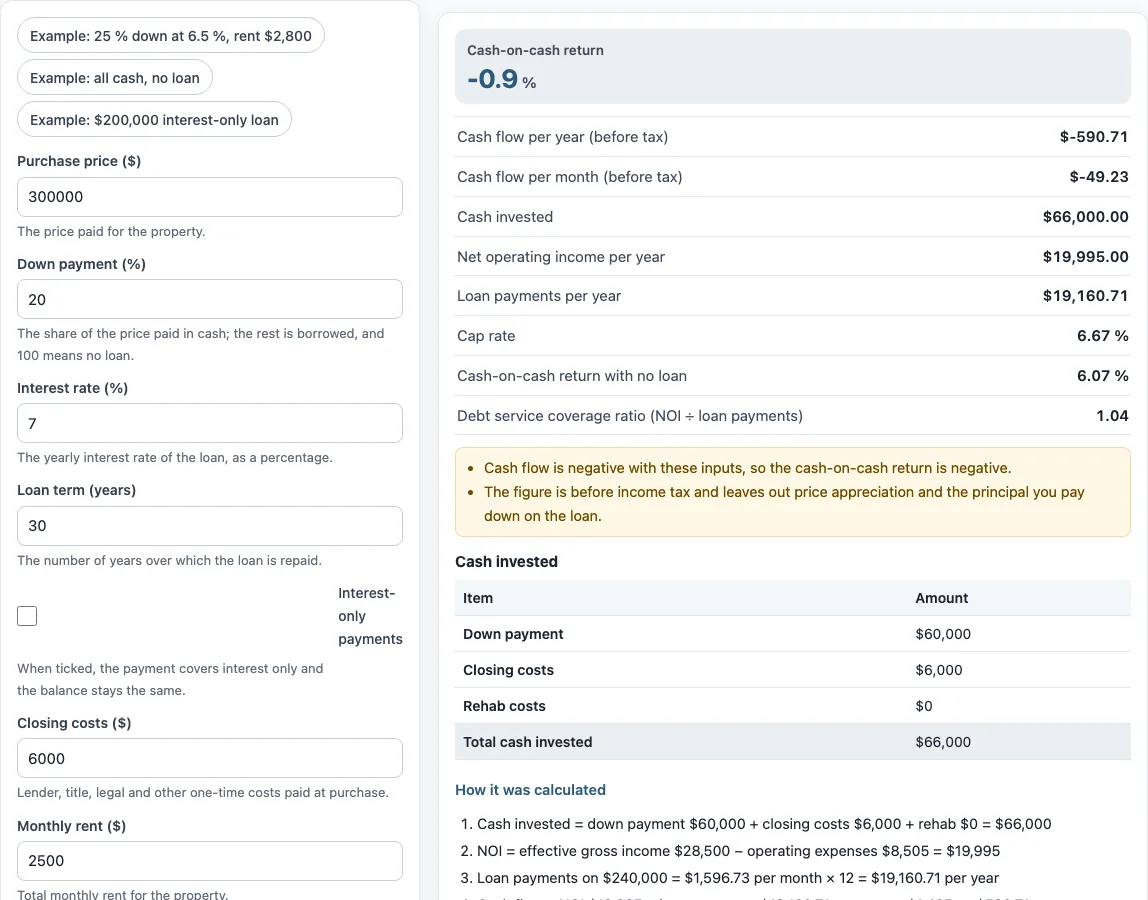
The three preset buttons load example inputs, and “Reset” restores the example values. The values in the form are an example, not market data, so replace every one with your own numbers. Under the result, “How it was calculated” shows each step with your figures. “Print / save result” prints a one-page sheet with the inputs, results, steps and date; save it as PDF from the print dialog. “Copy link” copies a link that reopens the same inputs.
What is included in cash invested?
Cash invested is the cash you actually put into the property. It includes the down payment, the closing costs paid at purchase, and any rehab or initial repair costs, but it does not include the loan.
In the tool’s default example, cash invested is $60,000 down payment + $6,000 closing costs + $0 rehab = $66,000. The “Cash invested” table shows each part. Some lenders and investors define cash invested differently, so check the definition used in any document you compare against.
Because the denominator is cash invested and not the purchase price, the loan size changes the result. With no loan, the figure equals the all-cash return. The tool shows this as “Cash-on-cash return with no loan”, which is 6.07% in the example.
Is cash on cash return before or after tax?
It is before income tax. The tool labels cash flow as “Cash flow per year (before tax)”, and the cash-on-cash return is built from that figure. The calculator does not work out income tax, depreciation or capital gains, so any tax effect is outside the result.
The formula is:
Cash on cash return = annual pre-tax cash flow ÷ total cash invested, as a percentage.
Cash flow is net operating income (NOI) minus annual loan payments, minus capital reserves if you enter them. In the example: $19,995 NOI − $19,160.71 loan payments − $1,425 reserves = −$590.71. Then −$590.71 ÷ $66,000 = −0.9%. Because cash flow is negative with these inputs, the return is negative.
The result also leaves out principal paid down on the loan and any price appreciation. The cash on cash return equation and the cash on cash yield formula refer to this same ratio.
How do I use the result?
Read the cash-on-cash return together with the figures beside it: annual cash flow, cash invested, NOI, annual debt service and the cap rate. In the default example the annual cash flow is −$590.71, which is the NOI of $19,995 less loan payments of $19,160.71 and reserves of $1,425. Changing the down payment changes both the loan payment and the cash invested, so try a few values to see how each input moves the ratio. The percentage shows only the first year of cash flow; it says nothing about later years, a sale or tax.
Frequently asked questions
How is cash on cash different from cap rate?
Cap rate compares NOI with the purchase price and does not depend on how the property is financed. Cash on cash return compares cash flow after loan payments and reserves with the cash invested. In the default example, the cap rate is 6.67% and the cash-on-cash return is −0.9%.
Does a negative result mean the property is a bad deal?
The tool does not judge deals. It is arithmetic only and gives no investment, loan, tax or legal advice. A negative figure means cash flow is negative with the inputs you entered.
Does the result include loan principal I pay off?
No. Principal paid down and price appreciation are left out, and the result covers one year only. Changing the “Interest-only payments” checkbox changes the loan payment, which feeds into cash flow.
Can I use the results in a client report or listing?
Yes. Results may be used in commercial work such as reports, listings, lease comparisons and client documents, without attribution.
Does the tool keep the numbers I enter?
Nothing you type is uploaded, and the tool runs in the browser. The page address keeps your inputs after any change, so you can reopen the same figures with the link.
Why does the loan size change the result?
The return is divided by cash invested, not the purchase price, so a larger loan lowers the cash invested and changes the ratio. In the example, the no-loan return is 6.07%, while the financed return is −0.9%.
Related tools
- Cap rate calculator - Use it to compare NOI with the purchase price, without the loan.
- NOI calculator - Use it to work out net operating income before loan payments.
- DSCR calculator - Use it to compare NOI with loan payments.
- Rental yield calculator - Use it to measure rental income against the property’s value.
- Gross rent multiplier calculator - Use it to compare price with gross annual rent.
- 1 percent rule calculator - Use it for a quick check of monthly rent against the purchase price.
- Rental property calculator - Use it to work through the full set of rental income and expense inputs.