BRRRR Calculator
Enter the purchase, rehab, after-repair value and refinance terms to see the cash left in the deal.
Recent
Your last 10 settings, saved only in this browser. Nothing is uploaded.
How to use the BRRRR calculator
- Enter the “Purchase price ($)” and the “Rehab cost ($)”.
- Enter the “Closing costs at purchase ($)”, “Months until the refinance (months)” and “Holding costs per month ($)”.
- Enter the “Loan used to buy (0 = cash purchase) ($)”. Enter 0 for a cash purchase.
- Enter the “After-repair value (ARV) ($)”, taken from an appraisal or comparable sales you have found.
- Enter the “Refinance loan-to-value (%)”, “Refinance interest rate (%)”, “Refinance loan term (years)” and “Refinance costs (%)”.
- Enter the “Monthly rent after rehab ($)”, “Vacancy allowance (%)”, “Property tax per year ($)” and “Insurance per year ($)”.
- Open “More options” to enter “HOA fees per year ($)”, “Other operating costs per year ($)” and “Offer rule percentage (%)” if they apply.
- Enter the “Maintenance and repairs (%)” and “Property management (%)”, then read the results.
The preset buttons “Example: cash purchase”, “Example: bought with a loan” and “Example: larger rehab” fill the form with sample inputs. “Reset” restores the example values. Under the result, “How it was calculated” lists each formula step with your numbers. “Print / save result” creates a one-page sheet with the inputs, results, steps and date; choose save as PDF in the print dialog. “Copy link” copies a link that reopens the same inputs.
Nothing is saved on the site: the page address holds your inputs, so keep the link if you want to return to the same figures.
What does BRRRR stand for, what is the BRRRR strategy in real estate, and the BRRRR method explained?
BRRRR stands for Buy, Rehab, Rent, Refinance, Repeat. You buy a property that needs work, repair it, rent it out, refinance it with a new long-term loan based on its higher value, and use the cash returned toward the next purchase. Searches for brrr method, brrr loan and brr property refer to the same sequence, so the calculator covers each of these steps in order.
How is cash left in the deal calculated?
Cash left in the deal is the cash invested before the refinance minus the cash returned at the refinance. The tool builds these figures in a fixed order:
- All-in cost = purchase price + rehab + closing costs + holding costs (months × monthly holding cost).
- Cash invested = all-in cost − any loan used to buy.
- New loan = after-repair value (ARV) × refinance loan-to-value %.
- Cash out = new loan − any loan used to buy − refinance costs.
- Cash left in the deal = cash invested − cash out.
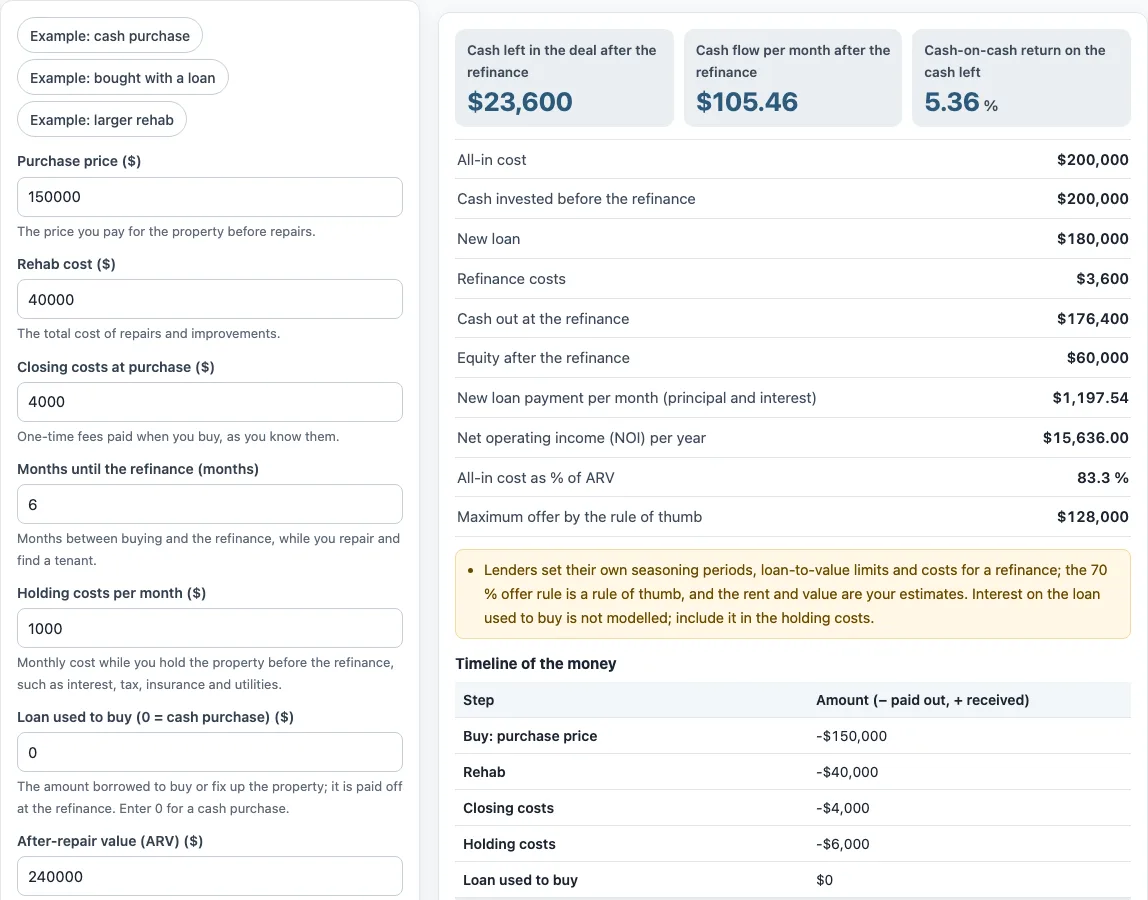
In the default example, the all-in cost is $200,000 and, with no loan used to buy, the cash invested is $200,000. The new loan is $240,000 × 75% = $180,000, and the refinance costs are $180,000 × 2% = $3,600. Cash out is $176,400, so $23,600 stays in the deal.
If cash out is larger than cash invested, the excess is shown as “Cash returned beyond your investment” and cash left is 0. Cash-on-cash return is not defined when no cash is left. Lenders set their own refinance terms, and the ARV is your estimate, so the result is only as accurate as those inputs.
What happens after the refinance?
After the refinance, the calculator shows what the property earns and what you own. In the default example, net operating income is $15,636 a year and the new loan payment is $1,197.54 a month, so cash flow after the refinance is $1,265.47 a year, or $105.46 a month. Equity after the refinance is the after-repair value less the new loan: $240,000 − $180,000 = $60,000. The all-in cost is 83.3 % of the after-repair value. These figures follow only from the numbers you type, and the rent, value and costs are your estimates.
Frequently asked questions
What is the 70 percent rule?
The 70 percent rule is a rule of thumb used by investors to estimate a maximum offer. It is ARV × 70%, minus the rehab cost. In the default example, $240,000 × 70% − $40,000 gives $128,000 under “Maximum offer by the rule of thumb”. The percentage can be changed under “Offer rule percentage (%)”.
Why may cash come back at the refinance?
Cash comes back when the new loan, less refinance costs, is larger than the cash you put in. The new loan depends on the ARV and the refinance loan-to-value that the lender sets. In the default example, cash out of $176,400 is less than the $200,000 invested, so $23,600 remains in the deal.
What is the brrr meaning in property?
“Brrr” is a shortened way of writing BRRRR. A brrr property is a property bought, repaired, rented and refinanced under the BRRRR plan.
Does the BRRRR calculator include interest on a loan used to buy?
No. Interest on a loan used to buy is not modelled. Include it in “Holding costs per month ($)”.
Does the tool save my numbers?
Nothing you type is uploaded, because the tool runs in the browser. Your inputs stay in the page address as you change them, and “Copy link” gives you a link that reopens the same inputs.
Can I use the results in reports or client documents?
Yes. Results may be used in commercial work, such as reports, listings, lease comparisons and client documents, without attribution. The tool gives no investment, loan, tax or legal advice, so confirm refinance seasoning periods, loan-to-value limits and costs with your lender.
Related tools
- Rental property calculator: use it to work through the income and costs of a rental property.
- Investment property calculator: use it to compare the returns of an investment property.
- Rental ROI calculator: use it to see the return on a rental property’s cost.
- Rental property cash flow calculator: use it to check monthly cash flow after expenses.
- Cash on cash return calculator: use it to measure the return on the cash you invested.
- Rental property valuation calculator: use it to estimate a rental property’s value.
- Buy to let mortgage calculator: use it to estimate payments on a buy-to-let mortgage.